Building on the momentum of the Taskforce for Architectural and Engineering Consultants, the Quantity Surveyors (QS) Workgroup was established in February 2026 to study how the quantity surveying profession in Singapore can be strengthened and future-proofed, given the critical role QSes play in helping clients manage contractual and commercial risks, safeguard costs, and make better project decisions.
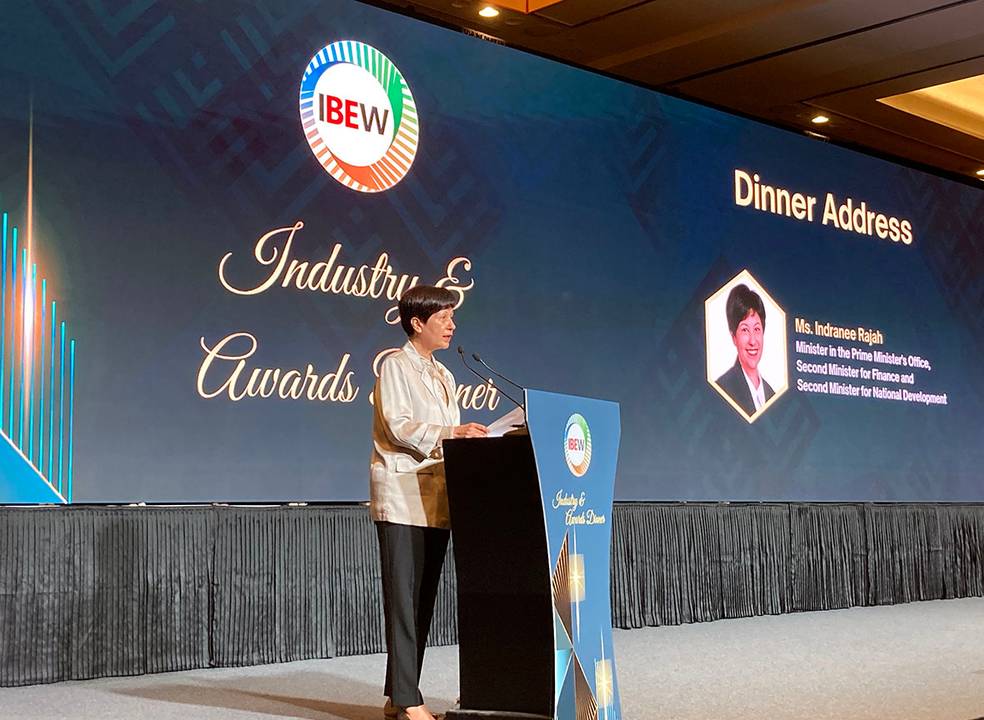
Speaking at the International Built Environment Week (IBEW) 2026 Industry & Awards Dinner on 4 September, Second Minister for Finance and National Development Indranee Rajah shared that over the past six months, the Workgroup has engaged more than 80 industry stakeholders, comprising service buyers, firms, industry associations, Institutes of Higher Learning (IHLs) and government agencies.
“What struck me from the engagements was the strong sense of purpose among quantity surveyors. As one description aptly put it, a good quantity surveyor is part lawyer, part accountant and part project adviser – yet the value they bring is not always well understood,” she said. “As projects become larger and more complex, the future of quantity surveying must be about creating greater value and taking on more strategic roles in project delivery.”
QS Workgroup recommendations
Following the engagements, the QS Workgroup developed recommendations structured around three priorities:
1). Attracting talent into the quantity surveying profession
The Workgroup has recommended a package of initiatives targeted at students through stronger outreach and clearer pathways:
-
To increase students’ awareness of the profession earlier, the Workgroup recommends introducing new quantity surveying content at IHLs. For example, (i) the National University of Singapore has introduced a new Specialisation in Contract Management and Cost Engineering within the Bachelor of Engineering (Infrastructure and Project Management) undergraduate programme in the Department of the Built Environment under the College of Design and Engineering, and (ii) stakeholders are exploring the introduction of QS elective modules at polytechnics, possibly starting with Singapore Polytechnic.
Together with the current Bachelor of Building and Project Management (BBPM) programme offered by the Singapore University of Social Sciences (SUSS), which provides training relevant to quantity surveying, these efforts will broaden talent outreach and the talent pipeline. -
To support students keen on pursuing quantity surveying as a career, the Workgroup recommends onboarding quantity surveying firms onto INSPIRE, an enhanced internship programme that gives students structured exposure to industry projects, dedicated mentorship and a clearer pathway into the built environment (BE) sector. INSPIRE interns may also receive higher starting salaries when they join their firms full-time after graduation.
-
The Workgroup also recommends efforts to strengthen the profession’s identity and visibility among the wider community, including parents and educators.
2). Developing and retaining quantity surveying professionals
For the second priority, the Workgroup recommends raising the professional standing and uplifting capabilities of QSes through recognition and accreditation:
-
The Workgroup recommends the wider use of professional accreditation, such as the Accredited Professional Quantity Surveyor (APQS) scheme. Accreditation provides QSes with a clearer pathway to demonstrate their competencies and progress in their careers, and also gives service buyers greater confidence when engaging QSes for more complex projects.
Over time, wider adoption of accreditation can strengthen professional standards, support better career progression, and make it more worthwhile for QSes to stay and grow in the profession. Several government agencies including HDB and JTC are already referencing the APQS scheme in their procurement. The Workgroup recommends that more agencies and private developers consider doing so. -
The Workgroup also recommends that the roles and responsibilities of QSes be formally recognised in standard construction contracts, such as the Public Sector Standard Conditions of Contract (PSSCOC) and other industry contract forms where applicable.
-
To support career progression, the Workgroup recommends adopting competency-based remuneration.
3). Enhancing the business sustainability of quantity surveying firms
To support an expansion beyond traditional services to higher-value areas such as collaborative contracting, early-stage cost advice, risk management and other strategic procurement advisory services, the Workgroup recommends leveraging technology and AI to streamline workflows and processes.
The Workgroup also recommends that the industry develop a value articulation framework (VAF) to define the various quantity surveying services delivered at each project stage. This could support quantity surveying firms in developing fee proposals commensurate with the scope, complexity and resources required, while enabling service buyers to make more informed evaluations of submitted bids, fostering a more transparent and equitable procurement environment.
The full list of recommendations can be found in this infographic and report.
Strengthening regulatory competency of QPs
Qualified persons (QPs) carry important responsibilities in ensuring that building plans and submissions comply with regulatory requirements, and that projects are delivered safely, on time and within budget. As Singapore’s building infrastructure ages and projects become more complex, the roles and responsibilities of QPs will become increasingly important. As such, it is crucial for them to continually upgrade their capabilities to maintain high standards of regulatory competency and uphold regulatory outcomes and professional standards.
The Board of Architects (BOA) and Professional Engineers Board (PEB), together with regulatory agencies, are exploring a more systematic approach to support QPs in keeping pace with evolving regulatory requirements. This could include closer monitoring of the quality of QP submissions made to regulatory agencies to identify areas where QPs may benefit from additional support, as well as efforts to develop QPs’ competencies, such as relevant competency bridging programmes.
More details will be provided at a later date.