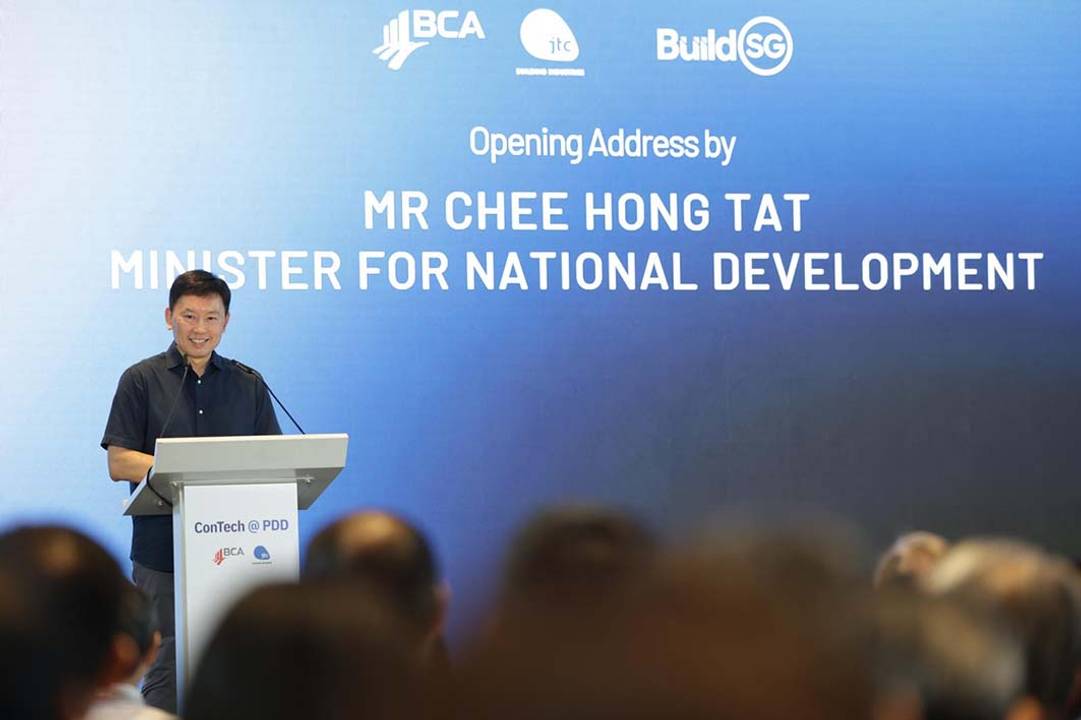
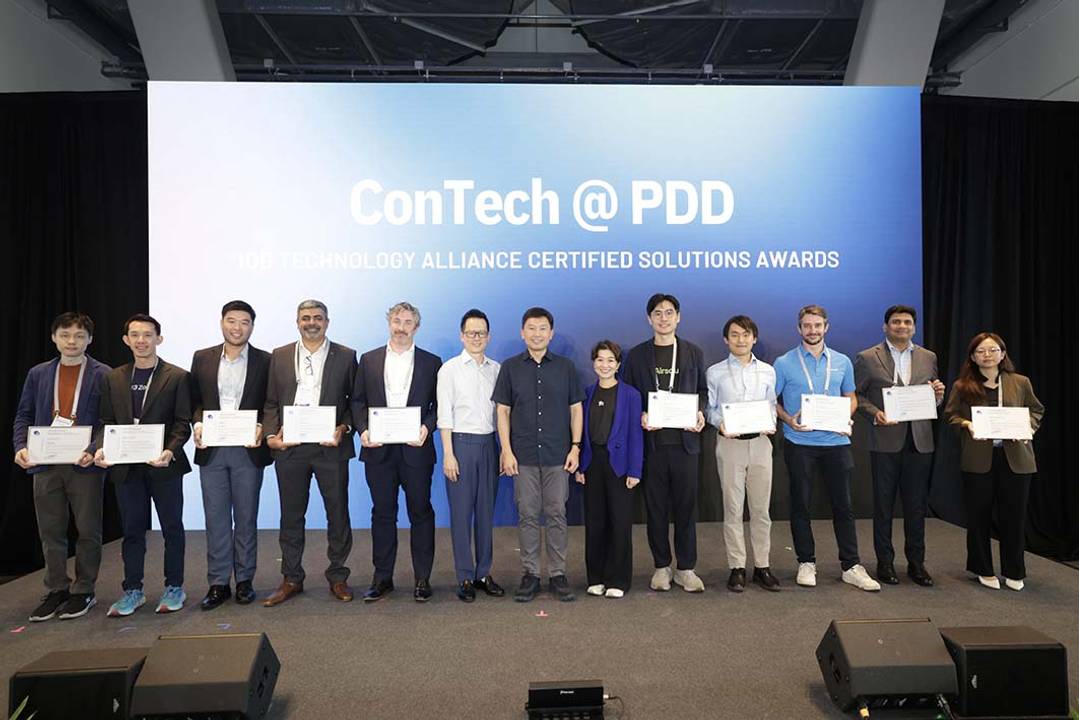
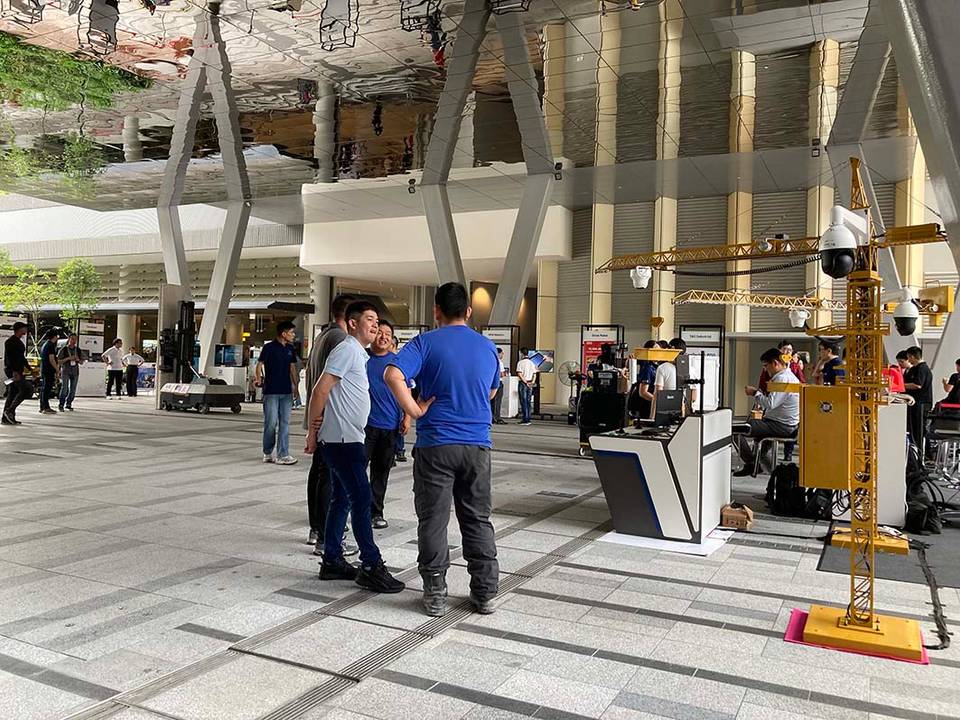
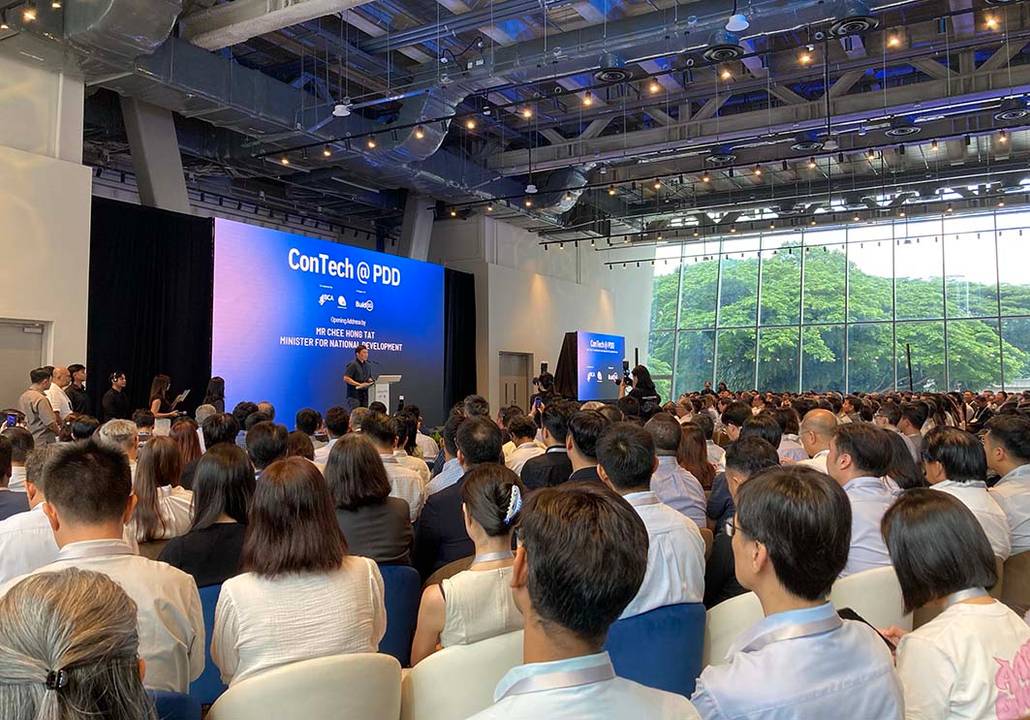
At the Construction Technology @ Punggol Digital District (ConTech@PDD) event on 17 July 2026, co-organised by the Building and Construction Authority (BCA) and JTC Corporation, Singapore’s Minister for National Development Chee Hong Tat announced new initiatives to support the transformation of the built environment (BE) sector.
Amid high construction demand, new technologies such as robotics & automation (R&A) will be key to helping Singapore’s BE sector build better, faster and more sustainably. To increase the adoption of market-ready solutions, the government will streamline rules and facilitate the scaling up of proven innovations.
Government sandboxes for testbeds
The government provides sandboxes for firms to pilot and test their innovations. One example is the Built Environment Innovation Hub (BEIH) at BCA Braddell Campus, which has hosted more than 170 technology demonstrations and testbeds since its launch in 2023, with about 60 featuring R&A solutions.
To make it easier and less costly to innovate, BCA will waive space rental fees for BEIH technology sandboxes for two years starting from July this year. “For a start, this will be offered to teams trialling solutions that improve productivity, such as R&A, which are currently the most common types of technologies test-bedded at the BEIH,” said Mr Chee. “And we can extend this waiver to other areas if there is demand for other types of technologies.”
According to BCA, the sandbox is open to local and overseas technology providers and BE firms, including those without a physical presence in Singapore. To be eligible, the proposed solution or process must be relevant to the BE sector, with a focus on improving construction productivity.
In addition, the solution should be at a stage where sandbox testing or demonstration would meaningfully advance its readiness for commercial deployment in Singapore – for instance, if it is new to market, has not yet been validated for local conditions, or requires adaptation to meet local building codes and requirements.
The sandbox space will be open to multiple projects and solutions concurrently. Interested parties may look out for the open call on BCA’s website here.
Complementing this, JTC will set up a sandbox at the Jurong Innovation District to test large-scale autonomous construction technologies and heavy construction equipment systems. The inaugural project is an inter-agency collaboration between JTC, the Public Sector Science and Technology Policy and Plans Office (S&TPPO) and the Housing and Development Board (HDB), in partnership with Kajima Corporation. More details on the sandbox and JTC’s robotics roadmap will be shared later this year.
IPP: scaling up innovations
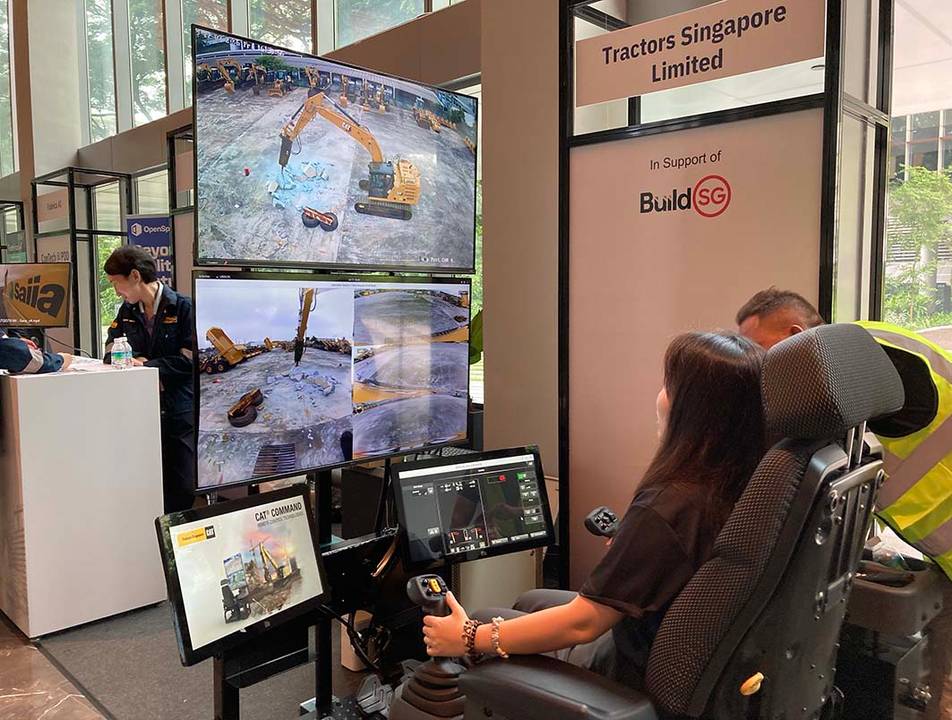
To make it easier for proven technologies to move from testing to real-world use, JTC will launch the Innovative Procurement Partnership (IPP) tender for technologies, including construction inspection robots and remote-controlled tower cranes.
“The IPP is a new government procurement approach that reduces administrative barriers for pilot testing, while allowing companies to subsequently scale up their innovative solutions for commercial deployment,” explained Mr Chee. “Under this approach, awarded tenderers whose pilots are successful can scale up their innovations to other JTC’s projects, without the need to go through new tenders.”
IPP is intended to help businesses – especially smaller or newer firms without a proven track record – participate in government procurement opportunities. The contract will be structured in two parts: a pilot phase followed by an option for deployment. If the pilot is successful, the government is able to award the option for deployment of the successful solution. This will benefit both parties by providing greater certainty for scaling up innovations, while streamlining the process into a single procurement effort.
To make IPP more accessible to SMEs and start-ups, the government will also share risks with businesses by waiving security deposits and liquidated damages during the pilot testing phase.
According to JTC, IPP is conducted via open sourcing, allowing any business to participate. In this way, it not only facilitates experimentation but also provides a clearer deployment pathway for innovative SMEs and start-ups to scale up their operations and move towards commercial success.
“As many of you will know, it is through the scaling up, when you achieve economies of scale, that you are then able to bring down the per unit cost, and that in turn, will be able to spur greater innovation,” said Mr Chee.
JTC received close to 20 submissions for its first two IPPs. These included innovative computer vision solutions to monitor worksite productivity (awarded to Invigilo AI and Vebits AI), and robotics solutions to automate time-consuming and potentially hazardous inspections of covered drains (awarded to MyrLabs).
In the coming months, JTC plans to launch more IPP tenders in areas such as construction inspection robots and remote-controlled tower cranes.
Streamlining rules and regulations
With feedback from stakeholders, the government continues to remove unnecessary red tape and ensure that rules and regulations keep pace with innovation.
As part of these efforts, the Ministry of Manpower (MOM) and BCA have reviewed the first batch of projects deploying smart hoists on construction sites and exempted them from the prevailing Workplace Safety and Health (WSH) requirement to station operators within smart hoists. This enables companies to achieve greater cost and manpower savings. To maintain safety, the projects will implement safeguards, including interlocks to keep hoist doors secure.
MOM and BCA will learn from this first batch of projects to streamline the process further. “For example, agencies may consider whitelisting smart hoist solutions that have proven safety records in future, so that there can be pre-approved exemption [from the rules],” said Mr Chee.
For firms that wish to find out more or request assistance on regulatory reviews, they can visit BCA’s website here.
IDDTA: supporting industry-wide adoption
To drive industry-wide adoption of successful innovations, JTC has onboarded the first batch of solutions to its Integrated Digital Delivery Technology Alliance (IDDTA). This initiative provides JTC’s project partners with a curated marketplace of digital solutions endorsed by JTC, which can connect to OPTIMUS, JTC’s connected data environment, to enable seamless information sharing across project teams from design through to completion.
“Construction companies looking to digitalise can save time and costs by adopting these proven solutions instead of going through their own trial and error process,” noted Mr Chee. “For technology start-ups, they can test and scale their innovations, while benefiting from IDDTA certification, which can help to open doors beyond JTC’s projects.”
Such an approach addresses a practical issue observed in earlier projects. JTC shared that, when specifying the use of new construction technologies, project partners sometimes had difficulty finding technology vendors that could meet JTC’s requirements. In some cases, vendors were appointed but unable to deliver the intended solutions after the contract was awarded.
IDDTA provides contractors and consultants with a list of certified technology partners for JTC’s projects, reducing the need for trial and error and helping them implement suitable solutions with confidence. For technology providers, JTC’s certification provides a proven track record that can strengthen their credibility and visibility beyond JTC and Singapore.
The first IDDTA batch covers three applications:
1). Digital precast and logistics tracking
The solution tracks precast components and site logistics from fabrication through delivery to installation – much like parcel tracking on an e-commerce platform – to more seamlessly coordinate the production of precast components.
Selected solution providers: Capps Solutions Pte Ltd, LeapThought Asia Pte Ltd, Novade Solutions Pte Ltd, and Ynomia Ltd.
2). 360° ‘at-grade’ reality capture
The solution builds a periodic, navigable visual record of site conditions at ground level, similar to a street-view service, to support progress, quality and safety monitoring.
Selected solution providers: Airsquire Pte Ltd, Cupix Asia Pacific Pte Ltd, and OpenSpace Inc.
3). Drone-based reality capture
A). Site-wide progress and survey monitoring
The solution conducts reality capture from the air, covering areas that are difficult to document from the ground, with a focus on site-wide progress, land surveys and earthwork measurements.
Selected solution providers: Pix4D SA, OpenSpace Inc, and Cupix Asia Pacific Pte Ltd.
B). Quality and defect Inspection
The solution conducts reality capture from the air, covering areas that are difficult to document from the ground, with a focus on quality and defect inspection.
Selected solution providers: Operva AI Pte Ltd and H3 Zoom Pte Ltd.
More applications will be added in due course, including construction robotics solutions.
Image credits:
Images 1 & 2: Ministry of National Development